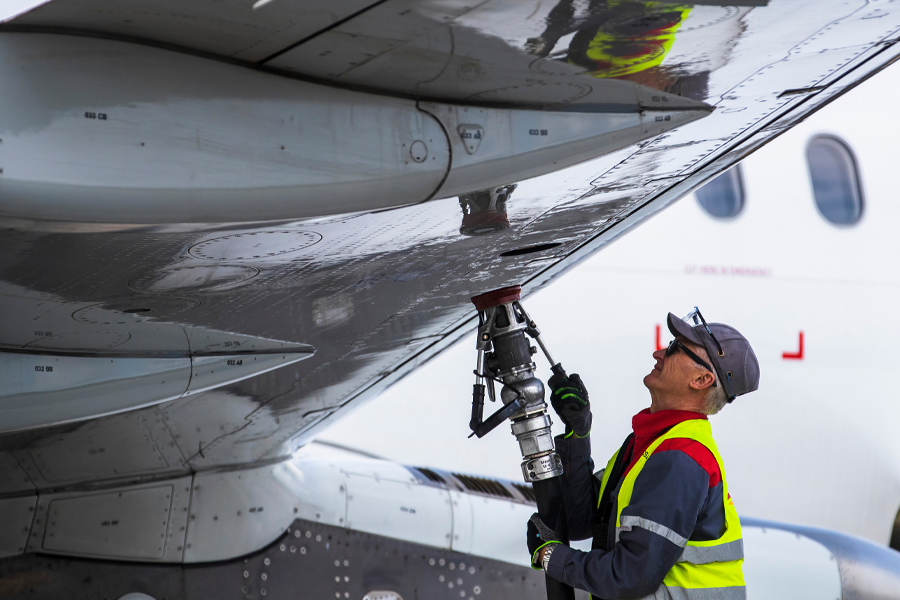

Higher fuel prices will “inevitably” lead to lower profits this year, according to Luis Gallego, CEO of IAG, speaking on a first quarter earnings call. The company expects its total fuel bill for 2026 to hit €9 billion (about $10.6 billion) — €2 billion (about $2.4 billion) higher than earlier predictions. IAG owns British Airways, Iberia, Aer Lingus, Level and Vueling.
Executives also said that the rising cost of fuel will be “partially offset” by its fuel “hedging” strategy and that its airlines remain 70% hedged for the remainder of the year. (Fuel hedging is when an airline locks in a future fuel price to protect itself from sudden spikes in jet‑fuel costs.)
Still, Gallego said the company needs to increase fares to mitigate the impact of fuel prices increasing. He said that long-haul and premium markets would be the focus, while fare increases on short-haul, intra-Europe routes would prove “difficult” due to regional competition.

However, Gallego said that “trading remains positive across the group, and very strong, with resilient demand, so we don’t see any weakness for the time being.” Additionally, outgoing CFO Nicholas Cadbury said that 80% of the group’s second quarter capacity has already been sold, and third quarter sales have reached 40% so far.
“We are well-hedged so we will manage this crisis much better than others,” Gallego said. He continued: “We are sure that some airlines in Europe will have difficulties, so they will need to reduce capacity. That can be an opportunity for us, so we expect to be even stronger after this crisis than we were before.”
IAG reported a 1.9% year-on-year increase in revenues for the first quarter, reaching €7.16 billion (about $8.4 billion). This was driven by strong premium demand across the group’s transatlantic network, according to executives, where business travel was “notably strong” from North Atlantic points of sale, particularly for British Airways.
Operating profit for the group increased by 77.3% to €351 million (about $413.6 billion) as the quarter was “relatively unaffected” by the Middle East conflict. However, higher fuel costs are expected to have a “more substantial impact” in the coming months.
IAG’s total capacity for the quarter—measured in available seat kilometers (ASK) —increased 0.2% compared with the previous year, while passenger revenue per ASK improved 3.5% year on year.
British Airways posed an operating profit of £186 million (about $253.6 million) for the quarter, up £90 million (about $122.7 million) year on year. Iberia’s profit rose €27 million (about $31.8 million) to €614 million (about $723.6 million). Aer Lingus and Vueling, however, reported losses of €103 million (about $121.4 million) and €28 million (about $33 million), respectively, with the Irish carrier facing higher fuel costs and more competition on transatlantic routes.