Generational labels are a red herring when it comes to characterizing cohorts in a traveling population, according to three experienced travel managers. Ginny Roelant, corporate travel manager at TechnipFMC, an oil and gas industry company, Kathy Kaden, global travel manager at Okta, an identity and access management company, and Darla Carmona, corporate travel specialist at Country Financial, spoke during the June Business Travel Executive Town Hall broadcast on LinkedIn.
The real factors are the field itself, company culture, what tech a person grew up with and the economic circumstances when they joined the workforce. These are the clues for managers on designing programs and policies that fit different employee cohorts, and communications to them.
“The fault line is adaptability instead of generations,” Roelant said.
“The culture of the company may have some roots in the demographics,” Kaden noted. “You have to be able to be technologically proficient if you’re going to work in the tech sector. So there’s some grounding in the demographics, but overall it is the company culture.”
A person’s position and mission also go a long way in shaping travel behavior. Think stakeholders rather than stereotypes. Executive assistants and infrequent travelers have different needs when preparing for trips.

The driving factors produce variability across booking tendencies, lodging preferences, risk profiles and many other aspects of travel.
Roelant alluded to a “true vulnerability” from relying on artificial intelligence for everything and emphasized the need to offer several booking options. “Even within the demographics, there are different preferences based on the adaptability natural to that human,” she said. “We have to offer more now than we ever have. There’s an array of consumer-driven practices that are pushing us forward.”
At Country Financial, Carmona said, some travelers want to use human agents because they always have. That’s despite AI built into the company’s designated booking tool “that will do everything for you,” Carmona explained. “They still make the phone calls when they could have everything completed in seconds.”
Others will book directly through supplier apps, jeopardizing duty of care. “There’s a lot of people who don’t want to reach out to anybody,” Carmona said. “They just want to get it done.”
For Kaden, one challenge is that employees don’t know the options. When a traveler needs to make a change but cannot do so in the online booking tool – and doesn’t realize humans are available – they may go directly to the supplier. That can mean falling out of their employer’s view. If they instead call in to the travel department, the first question back to them is whether they tried to call a counselor.
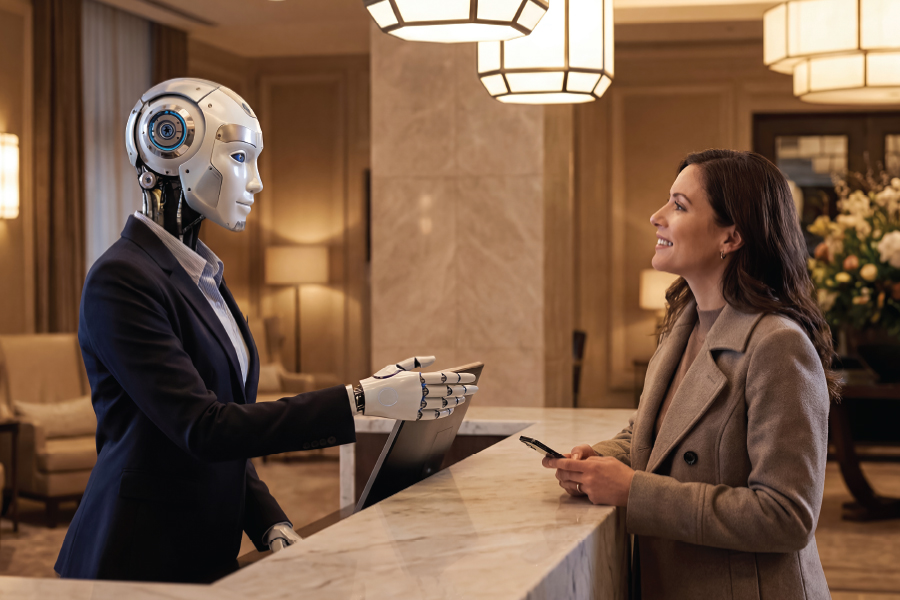
“We frequently have to remind people that there is support,” Kaden said. “There is backup beyond what you see on your screen. AI is fabulous, but you need to make sure that people know there’s a human in the loop.”
There’s a travel marketing trope that says Millennials popularized blended travel – adding personal time to a business trip. Age may be a correlation, but profile is the real driver. Imagine how different business travel is for a nursing mother of any age versus a 22-year-old living on their own.
With Okta growing quickly outside the United States, workers from all generations want to visit overseas offices. If blended travel is more prevalent among younger employees, Kaden noted, it’s likely because more of them haven’t yet had those experiences. Boomers in the same boat could be equally keen.
Another common perception is that younger employees care more than older ones about sustainability, but the buyers said awareness and action were often driven more by organizational philosophy and personal principles. The panel doubted a junior worker would be more likely to reject a business class seat because it has a smaller environmental impact than one in coach.
One Traveler, One Policy?
Understanding the personas is a first step in managing diversity.
“We take a business case into the policy that governs the experience and the booking technology and any automated messaging, and we define that by what we’ve identified as the different traveler populations to enhance that booking experience,” Roelant said. “It’s not really about what their entitlements are while traveling; it’s what they’re going to see inside the technology when they’re shopping.”
At TechnipFMC, one persona is a group of travelers who frequently fly on routes with tight capacity. If they followed the general policy of booking only nonrefundable fares, they might get shut out. “We’ve made a persona-based exception based on this demographic in this region, that they will be booking fully refundable to ensure that they make it on the plane,” Roelant said.
Okta doesn’t use personas as a formal management tool, “but it’s definitely something that we take into consideration,” Kaden said. They may have assistants, but some executives – like much of the rest of the company – are tech-savvy and have a “DIY mindset. Could they potentially be missing out on something?”
Are truly personalized policies for individuals possible?
Kaden thinks it will happen, and sooner than many expect. As it is, companies typically have multiple policies, often one for executives and another for the general population. The reason there aren’t more flavors is the challenge of making changes across all of them, according to Kaden, but “as technology advances, it’s going to become much easier to have policies for one. There’s a benefit to that.”
The outcome could be akin to automating exceptions, whereby the details determine the policy. For example, companies barring travel to a conflict zone may want to programmatically allow employees who reside in the impacted countries to book travel with fewer restrictions. Policies, procedures, pre-trip briefings and other considerations can be tailored to address specific needs of women, people with physical or mental health issues, LGBTQ travelers and other groups.
The Emoji Attention Span
A compounding challenge is communicating everything to all relevant parties. Because no single method reaches everyone, the buyers recommended multiple channels.
At Country, Carmona sends quarterly newsletters to 4,000 employees. The 35 admins booking for senior leaders get monthly e-mails and quarterly conference calls. Despite those efforts, “there’s always that misconnection with our travelers,” she said. People still don’t know about important program elements, like the existence of a booking tool.
At Okta, the attitude of many employees is, “Tell me now, tell me quick, tell me in four lines or less, tell me with a whole bunch of emojis so I get excited about it,” said Kaden.
Okta has weekly office hours predominantly for executive admins, but the main focus is a central repository of travel program info and policies. It feeds an AI bot that helps guide travelers.
The company also uses Slack channels to regularly push out info on changes or items of interest – one for road warriors and another for meetings and events (even specific meetings). Within those channels, employees can interact with each other. As they do, the travel team can watch the chatter to ensure no one is sharing incorrect information.
Roelant has made “minor” progress on providing an AI bot via the company’s travel intranet. She hopes the bot ultimately will render the intranet page obsolete. “At least in my cohort, everybody uses AI for almost everything,” she said. “So positioning our information distribution – and eventually even our bookings – into an AI space is 100 percent the future.”
Visit businesstravelexecutive.com to listen to this complete LinkedIn Audio session and find details about the next BTE Town Hall.